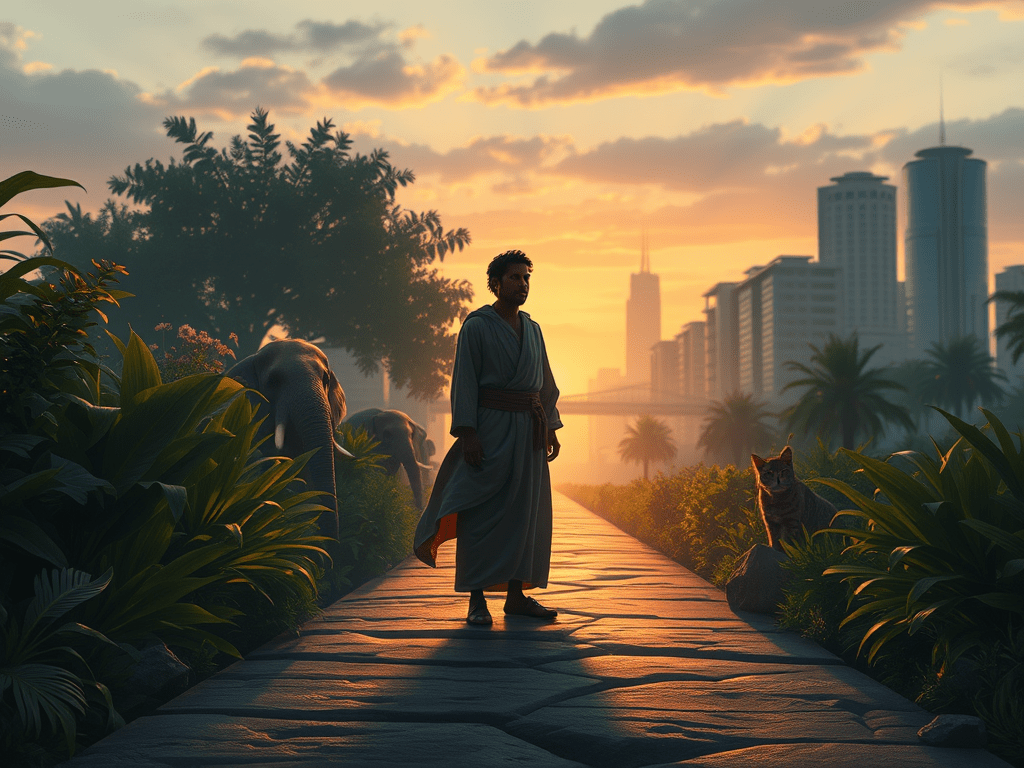
The question of what it means to be human has long preoccupied philosophers, theologians, and scientists alike. On the surface, humans appear to be animals—living beings shaped by instinct, biology, and environmental conditioning. However, on closer examination, certain unique human qualities begin to emerge. These include our language, sense of aesthetics, capacity for ritual, moral consciousness, and the ability to transcend even our most basic biological urges. This post explores these ideas by challenging the common assumptions about human-animal equivalence and drawing on documented animal behaviours, scientific commentary, and cultural observations.
Conditioned Behaviour: Are We Just Like Other Animals?
Animals, by and large, respond to their environment through conditioned impulses. A cat gives birth to a disabled kitten and allows it to be taken away without protest. Cats may even eat their kittens when they become a burden. There is no outcry, no mourning, no ethical hesitation—only instinctual preservation.
Yet contradictions abound. A cow chases after its calf as it’s taken away, displaying what looks like maternal grief. This appears analogous to a human reaction. However, researchers explain that such behaviours are opportunistic and based on immediate stimuli—visual, auditory, or olfactory cues—rather than memory or ritualistic mourning. There is no evidence cows remember their calves over time.
Elephants offer another fascinating example. They are known to interact with the bones of deceased herd members. While some have interpreted this behaviour as mourning, researchers caution against human projections: “There’s no evidence that elephants plan scheduled visits to bones like a ritual on a specific day. Rather, when they encounter the remains—driven by curiosity, olfactory cues, or the visual presence of bones—they may approach and interact with them. This behaviour appears spontaneous rather than premeditated, reflecting an opportunistic response rather than a fixed, planned event.” Perhaps it is so elephants recognise that this area is dangerous for them and they must avoid it.
In domestic animals, familial recognition is often based on immediate sensory input rather than emotional memory. Cats, for instance, may remember their littermates for up to two years but often do not recognize them after prolonged separation. One former vet explains that domestic cats lack a human-like concept of family. Hierarchy and social utility dominate instead. While mother cats may appear to bond with their kittens, their behaviour is primarily shaped by feeding needs and territory. Sons will attempt to mate with their mothers. Daughters may challenge or replace them in hierarchy. Recognition is mostly olfactory.
These observations suggest that what humans interpret as emotional bonds in animals are often socially advantageous behaviours. Anthropomorphising such behaviour can mislead us into assuming shared consciousness.
Beyond Compulsion: The Human Mother and the Animal Mother
A telling contrast lies in the maternal instinct. When kittens suckle, the cat may lie down passively. But if hunger strikes, she will leave them—even if they fall to the cold, hard tiles. The drive to feed overrides any conditioned maternal care.
Contrast this with the human mother. She may wake at 3am, exhausted and frustrated—knowing she must rise for work in a few hours. Yet she walks over to her crying infant. She lifts him, soothes him, offers him milk. The moment is marked not just by instinct but by conscious compassion. The emotional complexity—the despair, the resolve, the tenderness—transcends conditioning.
Rituals of Death: Human Mourning vs Animal Reaction
Elephants may interact with bones. Cows may chase after calves. But humans conduct funerals—marked by symbolism, ritual, and memory.
Funeral rites vary across cultures, yet they persist universally. Some cultures wear white, others black. Some offer flowers; others wear prayer shawls or light candles. Cremation, burial, sky burials, and funeral pyres—these practices demonstrate that human mourning is not simply a reaction to loss but a cultural, aesthetic, and often spiritual response to death.
This is a major divergence from animal behaviour. Mourning rituals signify a belief in memory, legacy, and even an afterlife—none of which are evidenced in non-human species.
Language and Aesthetics: The Essence of Humanity
Among the many differences that distinguish humans from animals, two stand out with remarkable clarity: language and aesthetics. Language allows us not only to communicate but to conceptualise, to imagine, and to construct entire worlds of meaning. Aesthetics elevates us beyond survival to create and appreciate beauty for its own sake. These faculties are not mere extensions of biology; they are cultural, symbolic, and often transcendent. Together, they form the bedrock of human civilisation, setting us apart from even the most socially complex animals.
Language: The Distinctive Mark of Humanity
Animal communication can be complex—whale songs, bird calls, chemical signals in trees. But these systems are generally limited to immediate contexts like mating, territory, or danger. Human language differs in fundamental ways:
- Symbolism and Abstraction: Human words are arbitrary symbols that can represent abstract concepts. For instance, the word “justice” has no tangible form but represents a vast network of values and interpretations.
- Generativity and Recursion: A finite vocabulary and grammar yield infinite expression, including nested or hypothetical ideas. A sentence like “If the doctor who examined the man that you met at the seminar believes in alternative therapies, then maybe we should reconsider our approach” demonstrates complex recursive structure that no known animal communication can replicate.
- Displaced Reference: We speak of the past, the future, the imaginary, and the moral—far beyond the here-and-now. For example, “One day, we might live on Mars” or “I dreamt that I was a bird flying over ancient Rome”—these statements transcend immediate reality.
- Cultural Transmission: Human language evolves quickly, generating dialects, literature, and complex technological systems. Consider how Shakespeare’s English differs from today’s, or how slang, memes, and technical jargon transform communication within a generation.
The example of the Hoopoe bird in Islamic tradition is telling: when asked why it was absent from Solomon’s army, it presented an excuse. The story, while allegorical, underscores the human fascination with attributing intentional language to animals. In reality, animals do not produce recursive, symbolic language with aesthetic or philosophical depth. Whale songs may vary over time, but serve to enhance mating or cohesion—not abstract storytelling.
The Aesthetic Sense: Beauty Beyond Survival
Animals often prefer colour and symmetry in mates, as these signal health and vitality—means to an evolutionary end. Humans, by contrast, pursue beauty even when divorced from practical function. A beautiful church would make a poor home, but humans invest resources into aesthetics for their own sake.
Beauty influences morality, too. “If you kill a moth, you are a hero; if you kill a butterfly, you are a villain”—aesthetic judgments bleed into ethics. While animals may be drawn to vibrant feathers or scents, only humans revere beauty in abstract ways—through art, architecture, and philosophy.
This is supported by Islamic theology: “God is beautiful and He loves beauty.” The Prophet Muhammad ﷺ said, “No one who has an atom’s weight of arrogance in his heart will enter Paradise.” A man asked, “But a person likes to dress well and wear good shoes.” The Prophet replied, “Indeed, God is beautiful and He loves beauty. Arrogance is rejecting the truth and looking down on people.”
Transcending Biological Imperatives
The classical signs of life are Movement, Respiration, Sensitivity, Growth, Reproduction, and Nutrition—summarised as MRS GREN. But humans regularly override these instincts.
Yogis sit motionless for years. Competitive free divers hold their breath far beyond natural limits. Fire walkers stride across coals through sheer will. A father, his hair pulled painfully by his child, does not flinch out of love or discipline.
Growth is more than cellular division. Humans grow intellectually, spiritually, emotionally. The cessation of physical growth does not mark the end of human development.
And reproduction—so fundamental in biology—is often voluntarily forsaken. Newton, Tesla, and Jesus ﷺ all lived without children. Billions of Muslims fast from dawn to dusk for a month every year, ignoring their nutritional conditioning in favour of spiritual aims.
Worship and Animal Symbolism
It is striking how many ancient civilisations deified animals. The Egyptians revered dogs and cats; Hindus worship Ganesh—the elephant-headed god. Perhaps this stemmed from observing animal behaviours that seemed human: the mourning of elephants, the loyalty of dogs.
Yet Ganesh is not the god of mourning or remembrance. These anthropomorphic projections reveal human attempts to see themselves in animals, often spiritualised. Still, the gods are not worshipped because they are animals, but because they signify traits elevated beyond instinct.
The Soul and the Divine Image
In Abrahamic theology, humans are distinct because they carry a divine essence. Islam teaches that God breathed His Ruh (spirit) into Adam. Christianity echoes this: “So God created mankind in His own image.”
This divine imprint explains the human inclination toward ritual, sacrifice, morality, and love that transcends compulsion. A mother, exhausted, angry, and sleep-deprived, still comforts her child. Not out of impulse, but out of duty, compassion, and conscious love. Unlike animals, this love is not extinguished by hunger or inconvenience.
Conclusion
The evidence suggests that while humans share biology with animals, they possess a higher order of being. Animals are driven by impulses conditioned through evolution and environment. Humans can choose. Language, aesthetics, morality, and ritual all speak to capacities beyond instinct.
This divergence may be rooted in the soul—a divine element that sets humanity apart. Man is animal, until he purifies himself to become human.
 Engraved Light
Leave a comment