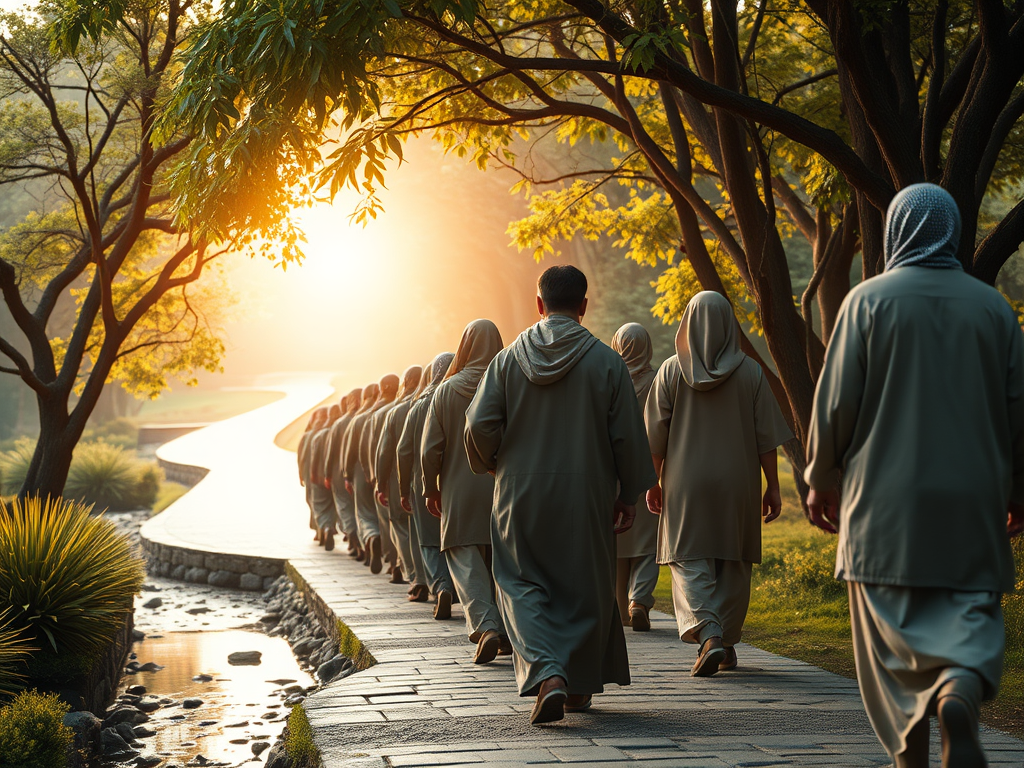
How a single word reveals the journey back to the soul’s first knowing of God
يَوْمَئِذٍ يَصْدُرُ النَّاسُ أَشْتَاتًا لِيُرَوْا أَعْمَالَهُمْ
“On that Day, mankind will return in scattered groups to be shown their deeds.”
— Surah Az-Zalzalah (99:6)
Introduction: Why This Reflection Matters
There are verses in the Qur’an that don’t just speak—they echo. Words that appear small but carry the weight of something we already feel, deep beneath language.
The word yasduru, in this verse from Surah Az-Zalzalah, is one such word. Translated simply as “they will come forth” or “they will return,” it seems straightforward. But behind it lies an entire theology of recognition, of return, of the soul finding its way back to the One it never truly left.
Why does this matter?
Because in a world that disorients us, distracts us, and fragments us, there is deep healing in remembering that our search for meaning, truth, beauty, and God is not the pursuit of something foreign. It is the homecoming of something innate. Something already engraved.
This is not an academic curiosity. It is a lived truth: the closer one comes to God, the more it feels like remembering, not discovering.
Reflecting on yasduru allows us to catch a glimpse of that return—not only in the afterlife, but even now. In our memories. In our rituals. In the places we return to. And in those still moments when the soul stirs and remembers what it was made for.
What follows is an exploration of that return.
The Day We Return: A Reflection on “Yasduru” in Surah Az-Zalzalah
يَوْمَئِذٍ يَصْدُرُ النَّاسُ أَشْتَاتًا لِيُرَوْا أَعْمَالَهُمْ
“On that Day, mankind will return in scattered groups to be shown their deeds.”
— Surah Az-Zalzalah (99:6)
There’s a quiet weight behind the word “yasduru” in this verse. Translations often render it as “emerge” or “come forth,” but a closer reading of the Arabic root ṣ-d-r (ص د ر) reveals something deeper—something that resists being reduced to movement alone.
The Root and Its Ripples
The root ṣ-d-r encompasses a constellation of meanings:
- To return, especially from a watering place
- To proceed, to issue forth from a source
- To turn back or depart
- To be placed at the forefront
- And, interestingly, ṣadr—the chest—where the heart lies
From the same root comes the word masdar, which classically referred to a well or watering place: a source. Somewhere life returns to be sustained. Not merely a point of origin, but a place of recurrence.
And so, yasduru might carry the sense of emerging not just from somewhere, but toward something familiar. A return to a known centre.
Masadir in Everyday Life
In human relationships, there are such places—masadir—that function as wells of connection. The friend one always meets at the same café. The childhood room where so many shared moments unfolded. The Friday mosque where hearts come home week after week. A kitchen table in Ramadan, where iftar is shared with laughter and warmth.
Even football stadiums become masadir. Not just arenas of spectacle, but emotional landscapes of collective memory. One doesn’t merely watch a match—one returns to an identity, a loyalty, a crowd with whom something sacred is experienced.
These places are not sacred in themselves. But they gather meaning. They act as anchors to something deeper—much like masadir in the desert, which sustain life by offering what the desert cannot: water, and the memory of water.
The Tension in the Verse
The verse says:
“On that Day, people will return in scattered groups to be shown their deeds.”
But return to where?
Is it that human beings are returning to a place where their deeds will be shown? Or that they are returning to their deeds themselves—being made to confront the lived sum of their life?
Or is the deeper truth that they are returning to God, and the showing of their deeds is merely the first act of that final meeting?
This ambiguity is not a flaw in the verse. It is the point.
The Qur’an often describes the final moment of return using similar language—“To your Lord is the return”—yet it rarely spells out what exactly that return looks like. This is not because it is hidden from us, but because it is already known by us—engraved in the heart, deeper than language.
Seeing One’s Deeds… or Recognising God?
There is an argument to be made: perhaps yasduru here simply means a logistical emergence—resurrection in scattered groups, followed by a divine reckoning.
But another possibility unfolds.
What if the soul is returning not just to a scene, but to a recognition? What if the “showing” of deeds isn’t just an external judgment, but an internal unveiling—like watching one’s entire life projected back not just on a screen, but on the soul itself?
There’s something uncanny in the idea of watching one’s own life from the outside. As if the “self” seeing is not the same self that lived. But the verse does not emphasise that fracture—it suggests instead a reunification.
And if so, perhaps the ultimate masdar we return to is not the record of our actions, but the One from whom we came. And the recognition of our actions is the veil being lifted, the means by which we are reintroduced to ourselves and thus to Him.
As if the question “What did you do?” is the doorway to “Who were you, really?”
And that in answering, we rediscover both our own soul and the One who shaped it.
The Fitrah and the Final Homecoming
This may explain why the Qur’an does not spell out the destination—because the destination was always within. The fitrah—the soul’s original knowing of God—is not a memory to be recalled but a truth to be re-recognised. Like a newborn seeking its mother’s breast without instruction, the soul knows how to return.
The deeds may be displayed—but the true moment is not that of judgment. It is of recognition.
Like a face seen after lifetimes.
Like a scent that brings back the whole of childhood.
Like a flame that the moth had been circling forever.
That is the return. That is yasduru.
Conclusion: The Return Beyond Language
So when the Qur’an says yasduru’n-nās, it is saying much more than “they will come forth.”
It is whispering that they will go back to what they always knew.
To the source that had never left them.
To the God who had engraved Himself into their being.
And in being shown their deeds, they will not just see their lives—they will see themselves.
And through themselves, they will finally see Him.
Not because they were told who He was.
But because they always knew.
 Engraved Light
Leave a comment