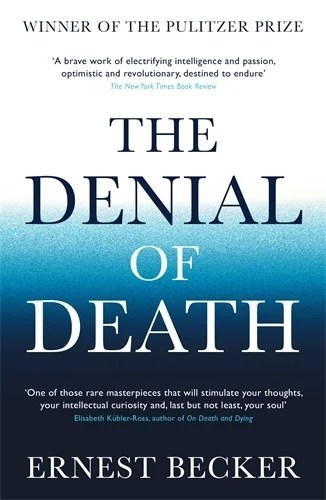
‘The Denial of Death’ by Ernest Becker is not the winner of the Pulitzer Prize for no reason. It is a masterpiece in analytical psychology that clearly presents the reader with an overview of the history of psychoanalysis. Becker begins by beautifully framing the human problem as one of ‘heroism’. This is the idea that all humans have a need to be ‘heroes’ in one way or another; whether this is by being the hero of their own family, protecting and providing for them, or the hero of a nation, leading their people from the clutches of the terrors of this life into a better existence.
He describes how, from the beginning of our lives, we find the need for a symbolic existence of ‘heroism’ in order to save ourselves from our the knowledge of our animal nature, especially highlighted by that point in our lives when we become acquainted with the fact that we, as all living organisms, excrete. Becker ties the idea of becoming aware of the fact that one excretes faeces with the knowledge that one will eventually die: faeces is the antithesis to life and it emerges out of every human.
Becker argues that much of the mental illness we see in the world (which has only increased since the publication of his book in 1973) is due to the inherent failure of this ‘hero’ project in a secular context. He explains how Freud’s conception of the Oedipal project is incomplete, drawing from Freud’s disciple Jung who questioned why Freud was so obsessed with the psychosexual analytic theory. Becker even, drawing from the authority of Fromm, Kierkegaard, and Rank asserts that Freud created his own private religion in the process of his merging of psychoanalysis and science.
Becker argues that man is inherently a ‘theological creature’. He claims that modern man tries to fill ‘the void’ left by the cultural death of God as proclaimed by Nietzsche by pledging allegiance to psychologists as ‘gurus’ or ‘prophets’ of the religion started by Freud. This shows up in the form of man distracting himself from the brute fact of his mortality by ‘transferring’ this concern onto, for example, a love object. He views those who are mentally ill, as a sliding scale from neurosis to psychosis all the way to schizophrenia as those humans that so clearly see the reality of death, but are unable to transfer their attention from death away in any meaningful manner.
“What did this author see that most people miss?”
Becker mostly forms his arguments based off of his readings of Rank, Brown, Kierkegaard, Freud and Jung. However, he beautifully synthesises these into a skeletal format for his main assertion: most of human activity can be explained as their denial of death. This is certainly something that we can all not only read in the book, but intuitively align with. For those who are non-religious, this is your biggest problem. You will die. What are you doing here on this Earth? What is your purpose? Account for your existence. For those who are religious, remind yourselves that this is the certain reality that God warns us about. We must live our lives according to his commandments, lest we be found by the Angel of Death in a state of disobedience.
“Where is this author wrong but useful?”
Becker argues early in his book in a small passage that Adam and Eve eating the fruit in heaven is what caused man to have knowledge of death. He seems to believe this is engraved onto man’s soul, and is the cause of his entire depressive condition on this planet. I think the author is definitely correct in his analysis of the actions of most of us, in that we do not fully understand the reality of death. How it shall take each and every one of us, ending our experience here on this Earth. However, I do not think this awareness comes from any original sin. In reality, death is perhaps the only certainty all humans can agree upon. It is not that we do not know death will occur or that the knowledge of it hidden in our subconscious causes us misery, rather that we are simply unacquainted with it. Animals are farmed far away from society in farms away from residential areas, bodies are prepared by funeral specialists rather than the families of the deceased. Even the burying rites are either foregone, with the opting of cremation instead, or the outsourcing to machinery.
I’d like to contrast the weakling ignorance of the modern man with a poem as recorded in ‘Diwan al-Hamasa’ by Abu Tammam to show how ancient societies, specifically the Arabs in late antiquity viewed death:
ولا يكشفُ الغَّماءَ إلاَّ ابنُ حُرَّةٍ
يرى غمراتِ الموتِ ثُمَّ يَزُورُهَا
نُقَاِسمُهُمْ أسْيَافَنا شرَّ قِسمةٍ
فَفِينا غواشيها وفيهم صُدُورُهَا
The translation of which is:
None uncovers sadness except the free man!
He sees the depths of death and goes to visit it!
We give them their share of our swords a horrid share!
So we hold the handles and in them are its blades!
The Arabs saw death and dying, especially for one’s tribe, as the greatest honour that a man could achieve. I do wonder what Becker would make of such a nation. It cannot be argued that they have ‘transferred’ their concern of death onto death. They seem to have accepted the fact of their mortality and the state of the world they find themselves in and have a total indifference to it. I think this is the heart of the modern Western problem. Honour is no longer a currency that is traded. Rather, dishonour has replaced honour. This is especially pronounced in the sexual deviancy of the West as a disease which has plagued most of the world. No doubt, this disease was always present in every human society. Such a devaluation of the currency of honour however, has not been seen (arguably) since the Roman Empire. In short: death is denied by modern man, as is his the fact that his honour arises only from the following of the commands of the Almighty:
يَـٰٓأَيُّهَا ٱلنَّاسُ إِنَّا خَلَقۡنَٰكُم مِّن ذَكَرٖ وَأُنثَىٰ وَجَعَلۡنَٰكُمۡ شُعُوبٗا وَقَبَآئِلَ لِتَعَارَفُوٓاْۚ إِنَّ أَكۡرَمَكُمۡ عِندَ ٱللَّهِ أَتۡقَىٰكُمۡۚ إِنَّ ٱللَّهَ عَلِيمٌ خَبِيرٞ
O mankind, indeed We have created you from male and female and made you peoples and tribes that you may know one another. Indeed, the most noble of you in the sight of Allah is the most righteous of you. Indeed, Allah is Knowing and Acquainted. (Q49:13).
 Engraved Light
Leave a comment